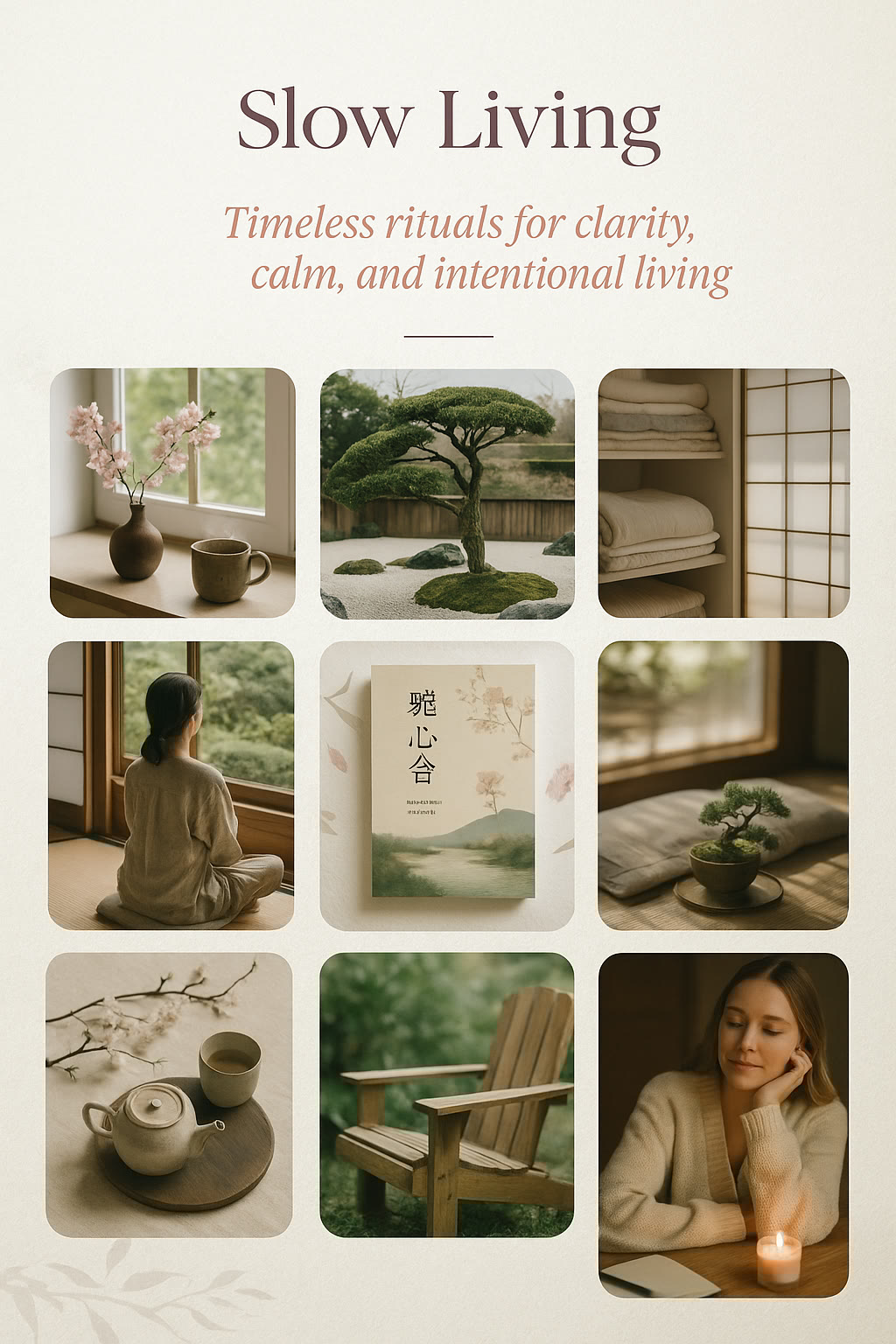
There’s a quiet wisdom woven through everyday life in Japan — a way of seeing beauty, finding peace, and living with intention. Rooted in centuries of philosophy, art, and ritual, these 15 Japanese concepts offer gentle guidance for modern life.
They speak to our longing for meaning, simplicity, and grace — not through perfection, but through presence.
Here’s a closer look at each one.
🧘♀️ 1. Wabi-sabi: The beauty of imperfection

Cracked pottery. Weathered wood. Fading leaves.
Wabi-sabi is the art of embracing imperfection — not just accepting it, but seeing it as beautiful.
Nothing lasts. Nothing is finished. Nothing is perfect.
It invites you to slow down and soften your expectations — of yourself, of others, of life.
🌸 2. Mono no aware: The bittersweet feeling of impermanence

Cherry blossoms fall. A candle flickers low.
Mono no aware captures that tender ache we feel when something beautiful is slipping away.
But instead of clinging, it teaches us to feel deeply, knowing the moment is precious because it passes.
It’s an invitation to witness life fully, in all its fleeting wonder.
☕ 3. The Japanese tea ceremony is about far more than tea
Every movement is intentional. Every object is chosen with care.
The tea ceremony is a quiet dance of presence, simplicity, and respect. Nothing is rushed.
It reminds us that even the most ordinary acts — pouring water, folding a cloth — can become sacred when done mindfully.
Ritual becomes a form of love.
🌿 4. Ikigai: The reason you wake up in the morning
What lights you up? What does the world need? Where do your gifts meet a purpose?
Ikigai is the intersection of passion, mission, vocation, and profession.
It’s not a grand quest, but a daily practice — noticing what brings meaning, joy, and flow.
It invites you to live from the inside out.
🪷 5. Shikata ga nai: “It can’t be helped”

The train is delayed. The rain won’t stop. Life throws something unexpected.
Instead of frustration, shikata ga nai offers a deep breath.
It’s not resignation, but grace — the strength to accept what’s outside your control and move forward calmly.
Like watching the rain, rather than fighting it.
🧹 6. Osoji: Cleaning as spiritual reset

Before the New Year in Japan, homes are thoroughly cleaned — not just for dust, but for energy.
It’s called ōsōji, and it’s a ritual of renewal.
Tidying becomes a way to honor your space, clear your mind, and begin again.
Minimalism meets mindfulness, with a broom in hand.
💧 7. Ma: The space between things

Silence between notes. Light between leaves. An empty room with soft morning sun.
Ma is not emptiness — it’s presence. The pause that allows beauty to breathe.
It reminds us that space is not something to fill, but something to feel.
Stillness is part of the music.
🎎 8. Gaman: Inner strength through endurance

To endure without complaint. To carry dignity even in discomfort.
Gaman is quiet resilience — staying steady through challenge.
A person standing in the rain, unshaken. Not because it’s easy, but because it’s necessary.
There’s power in patience.
🪞 9. Yūgen: A subtle sense of mystery and depth

A misty forest. A temple at dusk. A feeling you can’t quite name.
Yūgen is beauty that’s felt more than seen — something just out of reach, and more powerful because of it.
It invites you to let go of explanation and allow mystery to live.
Some truths are poetic, not literal.
🐚 10. Mottainai: Don’t waste what has value
A broken bowl repaired. Scraps turned into something new.
Mottainai is a deep respect for resources — not just money or things, but time, attention, and energy.
It reminds us: waste is not just environmental, it’s emotional.
Use what you have. Honor what you hold.

🔕 11. Seijaku: Serenity in the midst of activity

A monk walking calmly through a crowded street.
Seijaku isn’t silence — it’s stillness within the noise.
It teaches that peace isn’t found outside the chaos, but within your response to it.
It’s an inner posture of calm.
🧭 12. Datsuzoku: Freedom from routine

A spontaneous trip. A walk down an unfamiliar path.
Datsuzoku is the joy of breaking free from structure — letting go of “should” and stepping into surprise.
It’s where creativity breathes.
Sometimes, the soul needs something unplanned.
🍂 13. Kintsugi: The art of mending broken things with gold

Cracked pottery, repaired not to hide the breaks, but to highlight them.
Kintsugi teaches us that damage doesn’t diminish value — it adds to the story.
Your cracks are not flaws. They are golden seams.
Healing can be beautiful.
📿 14. Zanshin: The remaining mind

An archer releases an arrow — and stays fully present.
Zanshin is the awareness that lingers after action. A quiet attentiveness that doesn’t drop the moment something is “done.”
It’s the art of finishing well.
Stillness after movement. Focus after follow-through.
🧘 15. Mushin: The mind without mind

Flowing calligraphy. A sword in motion. A mind clear of fear and doubt.
Mushin is presence without ego — a state of fluid, instinctive action.
No hesitation. No overthinking.
Just you, and the moment.
Let these concepts live gently in your day.
You don’t need to master them all — just feel them.
Like petals in the breeze, they’re here to remind you: there is beauty in imperfection, grace in letting go, and quiet power in presence.